
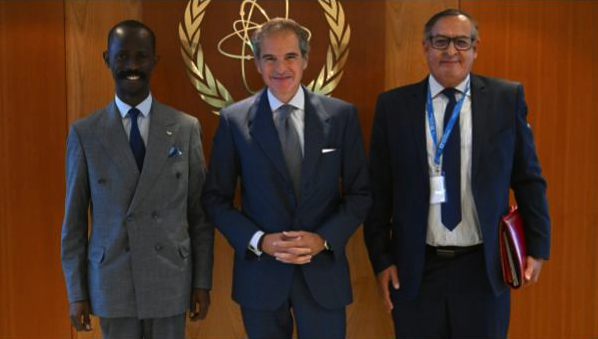
AFCONE Chairperson H.E. Gaspard LIYOKO MBOYO accompanied by Vice Chair H.E. Khammar MRABIT in a courtesy visit of IAEA Director General Rafael Mariano Grossi, in Vienna on 18/09/2026.
The African Commission on Nuclear Energy (AFCONE) successfully concluded its high-level participation at the 70th IAEA General Conference, reinforcing Africa’s commitment to the peaceful application of nuclear science and technology.
Led by the AFCONE Chairperson, H.E. Gaspard LIYOKO MBOYO, the AFCONE delegation actively advanced Africa’s peaceful use of nuclear science and technology, strengthened strategic partnerships, and reinforced the continent’s commitment to nuclear non-proliferation.
The annual high-level forum provides a critical platform for African Member States to align global nuclear advancements with continental priorities under the Pelindaba Treaty.
Delivering the General Statement at the IAEA Plenary, AFCONE Chairperson underscored the vital importance of nuclear science and technology in driving Africa’s Agenda 2063.
The statement highlighted key focus areas for the continent including the growing momentum for nuclear power infrastructure in Africa to address energy deficits, expanding the use of nuclear techniques in cancer treatment and crop optimization to ensure food security and development of skilled African workforce in nuclear science, with an emphasis on empowering youth and women.
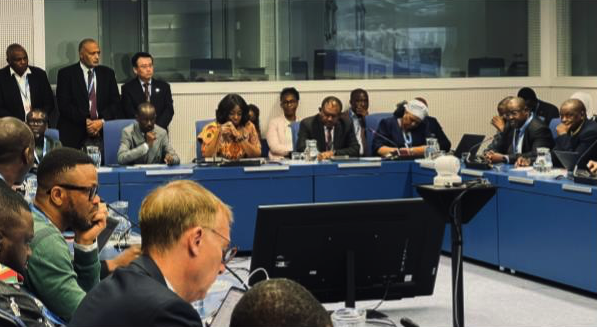
The Chairperson of African Group in Vienna H.E. Ambassador Matilda Aku Alomatu Osei-Agyeman in company of AFCONE Chairpeson H.E. Gaspard LIYOKO MBOYO gives opening remarks at AFCONE Side Event for Member States, in Vienna on 18/09/2026.
A major highlight of the conference was the dedicated AFCONE Side Event, designed to showcase the diverse nuclear energy and technology applications expanding across the continent.
The event put a spotlight on milestone activities being undertaken by different African States on Energy Planning & Nuclear Power, Breakthroughs in nuclear medicine and radiotherapy centers to combat the rising burden of cancer and deployment of isotope techniques to optimize water management, improve soil fertility, and eradicate pests.
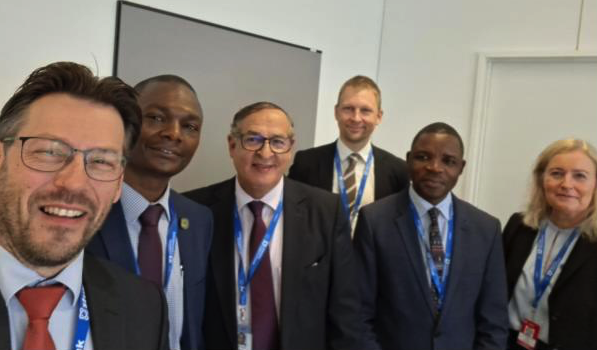
AFCONE and STUK delegations interacts after bilateral meeting in Vienna.
In a powerful demonstration of South-South cooperation, AFCONE and OPANAL (the Agency for the Prohibition of Nuclear Weapons in Latin America and the Caribbean) co-hosted a specialized side event.
Bringing together representatives from two of the world’s most prominent Nuclear-Weapon-Free Zones, the event underscored the shared responsibility of Africa and Latin America in promoting global disarmament. The discussion focused on joint strategies to enhance the peaceful use of nuclear technology, secure nuclear materials, and foster regional expertise without relying on weaponization.
The IAEA General Conference holds immense strategic weight for African nations. It serves as the primary gateway to technical cooperation funds, specialized equipment, and elite training required to deploy nuclear technologies safely. Because many African states face resource constraints, the conference offers unparalleled, direct access to global decision-makers and cutting-edge research in medicine, agriculture, and hydrology.
Furthermore, it is a vital stage to champion the Pelindaba Treaty (the African Nuclear-Weapon-Free Zone Treaty). The treaty does not simply ban nuclear weapons; it actively guarantees the inalienable right of African states to develop nuclear energy for peaceful purposes. By anchoring its presence at the IAEA, AFCONE ensures that global non-proliferation frameworks support, rather than restrict, Africa’s right to technological advancement and sustainable development.
African Commission on Nuclear Energy (AFCONE) in close collaboration with Finland’s Radiation and Nuclear Safety Authority (STUK).
The event was hosted with the critical local support and leadership of the Moroccan Agency for Nuclear and Radiological Safety and Security (AMSSNuR) and backed financially by the European Union (EU).
The program is dedicated to enhancing Nuclear Safeguards and Material Security across African Member States.
The capacity building is another significant milestone in AFCONE collective 5-year journey to “Uplifting Nuclear Safeguards in Africa.
This initiative exemplifies the power of global partnership. By bridging European regulatory expertise with Africa regional technical networks, we are actively constructing a sustainable, continent-wide infrastructure for safe and secure civilian nuclear programs.
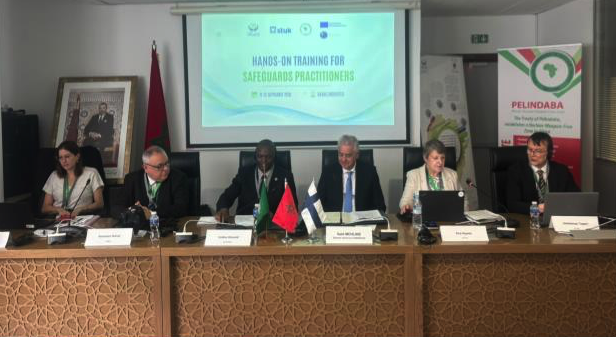
Dr Said MOULINE, the Director General of AMSSNuR officially opens the meeting in company of AFCONE Acting Executive Secretary Dr Collins OMONDI.
As African nations increasingly look toward civilian nuclear technology to satisfy growing socio-economic and energy needs under the African Union’s Agenda 2063, establishing independent and robust regulatory systems is paramount.
Nuclear safeguards act as the foundational technical mechanism to independently verify that nuclear installations and materials remain strictly dedicated to peaceful applications This initiative remains deeply tied to the obligations of the Pelindaba Treaty, which established the African Nuclear-Weapon-Free Zone. Under the treaty, State Parties commit to verifying non-proliferation compliance, primarily through Comprehensive Safeguards Agreements (CSAs) with the International Atomic Energy Agency.
By standardising legislation, upgrading tracking software, and boosting local technical capabilities, this joint regional program ensures that African states maintain full regional ownership of their security obligations while actively fostering safe, clean energy transitions across the continent.