
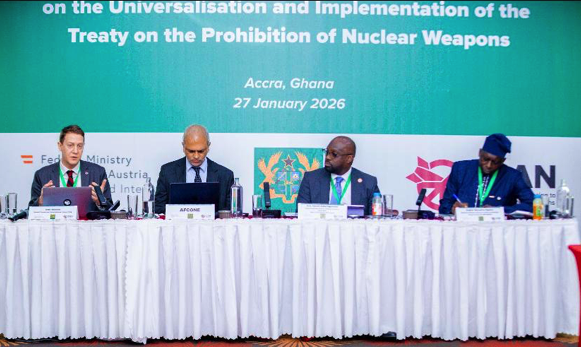
AFCONE Commissioner H.E. Laher Zaheer contributing to the West and Central African Regional Conference on the Universalisation and Implementation of the Treaty on the Prohibition of Nuclear Weapons (TPNW), in Accra, Ghana, on 27 January 2025.
The role of AFCONE in implementing the Treaty on the Prohibition of Nuclear Weapons agenda was the focal point during the Regional Conference on the Universalisation and Implementation of the Treaty on the Prohibition of Nuclear Weapons (TPNW).
AFCONE used the opportunity to underscore Africa’s longstanding commitment to the total elimination of nuclear weapons as the only absolute guarantee against their use or threat of use.
The meeting noted that since the 1964 OAU Declaration on the Denuclearization of Africa, African States have consistently supported global nuclear disarmament through regional initiatives, including through the establishment of a Continental nuclear-weapon-free zone.
The Conference was jointly hosted by the Governments of the Republic of Ghana and the Republic of Austria as well as the International Campaign to Abolish Nuclear Weapons (ICAN). The Conference took stock of the work achieved under the TPNW, promoted the universalisation of the Treaty as well as focused on the implementation of the Treaty ahead of the 2026 Review Conference.
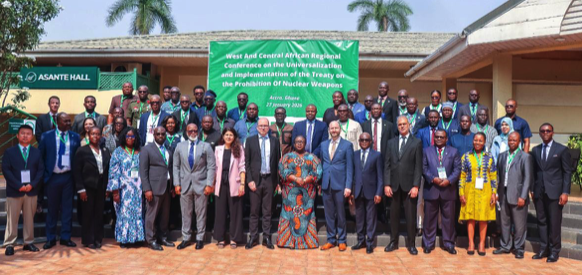
Delegation attending the West and Central African Regional Conference on the Universalisation and Implementation of the Treaty on the Prohibition of Nuclear Weapons (TPNW) pose for a group photo, in Accra Ghana, on 27 January 2025.
The keynote address was delivered by Ambassador Bankole Adeoye, Commissioner for Political Affairs, Peace and Security at the African Union. AFCONE was represented by Commissioner Zaheer Laher of the Republic of South Africa who delivered a statement on behalf of the Commission.
AFCONE’s statement further emphasised Africa’s pivotal role in advancing global disarmament, particularly through strong African support for the Treaty on the Prohibition of Nuclear Weapons (TPNW). The complementarity and synergy between the Pelindaba Treaty and the TPNW was emphasised. The shared humanitarian foundation, common prohibitions and mutual reinforcement of global and regional norms against nuclear weapons between the two treaties was noted. It was stated that both treaties aim to prevent the catastrophic humanitarian and environmental consequences of nuclear weapons, while affirming the right to the peaceful use of nuclear energy and supporting the central role of the NPT in the global disarmament and non-proliferation architecture.
The AFCONE statement indicated that African States already comply with all TPNW prohibitions through their obligations under the Pelindaba Treaty. Thus, accession to the TPNW would not impose additional constraints but would strengthen legally binding commitments at the global level. Universal African ratification of the TPNW would reaffirm the continent’s historic stance on nuclear disarmament and enable Africa to leverage its regional experience to further strengthen international norms against nuclear weapons and their catastrophic humanitarian consequences.